Sell and serve in the same conversation
A good store associate never sends you to another counter to ask about sizing, then a different one to check on your order. Give your visitors that same range online, in one thread — instead of a shopping bot and a support bot that have never met.
 Adrian LunaSVP of Growth, Webscale AI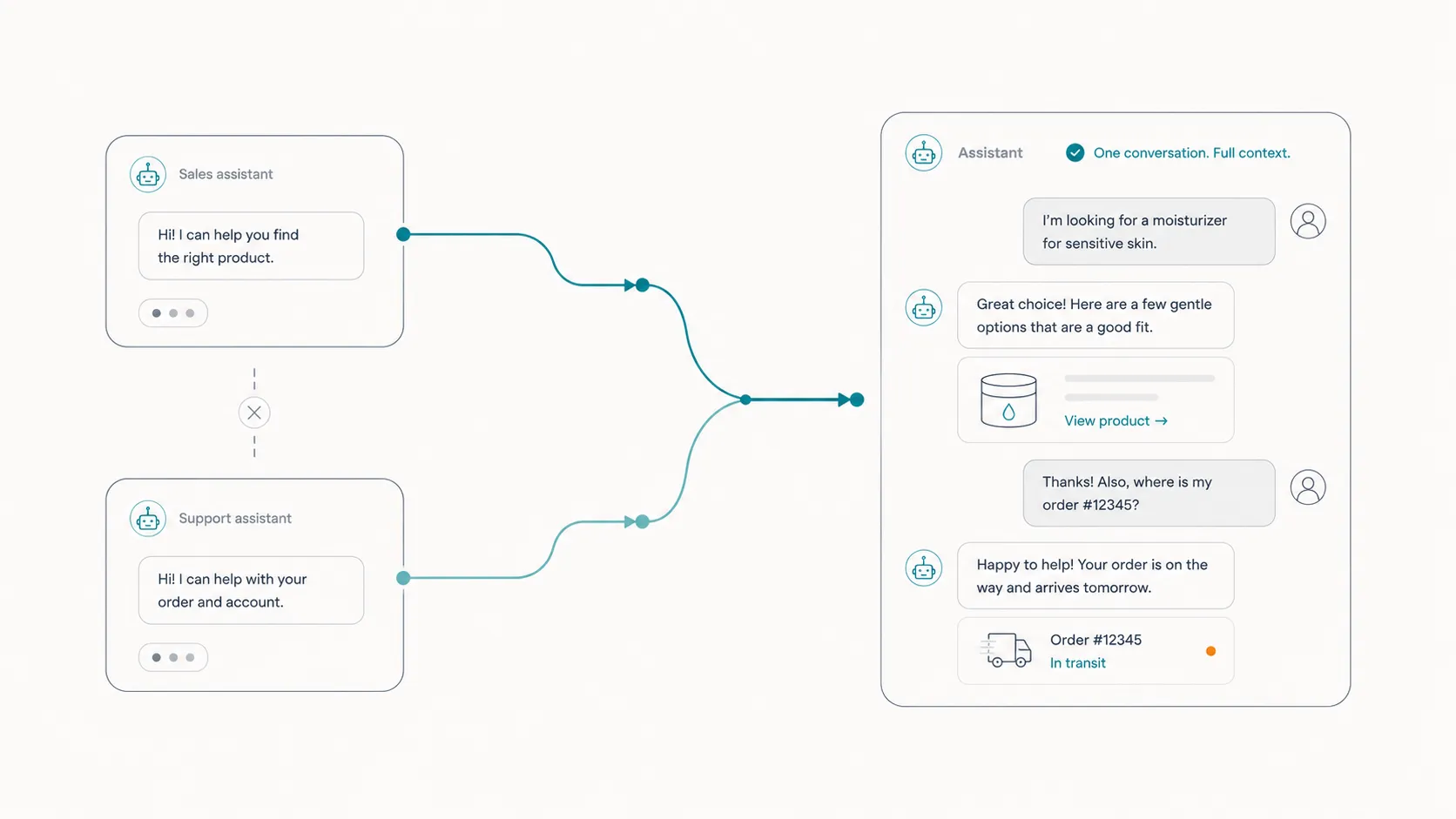
We already know what good help looks like
Walk into a store you trust and ask the person nearest you almost anything. Does this run small. Is the blue one back in stock. Can I return the one I bought last week. You do not expect them to shrug and point you toward another department. You expect them to just know, or to go find out without making you start over.
That expectation is not a nice idea about customer service. It is measurable. Research out of the Wharton School found that how much a sales associate actually knows about the product, and whether a shopper believes the item is in stock, matters more to overall visit satisfaction than almost anything else a store can control. Half of shoppers say they are actively looking for expert advice the moment they walk in, and most say product knowledge is what they need most from the person helping them. When Experticity studied trained versus untrained associates, the ones who had completed even one training module sold meaningfully more, and the gap kept growing the more they knew.
Of shoppers are actively looking for expert advice the moment they walk in — and most say product knowledge is what they need most from the person helping them.
Source: Wharton School, Marshall Fisher researchNone of that is about friendliness. It is about range. The associate who can answer a fit question, check a shipment and process a return without handing you off is worth more to the store, and to you, than three specialists who can each only do one of those things.
Then we built the opposite online
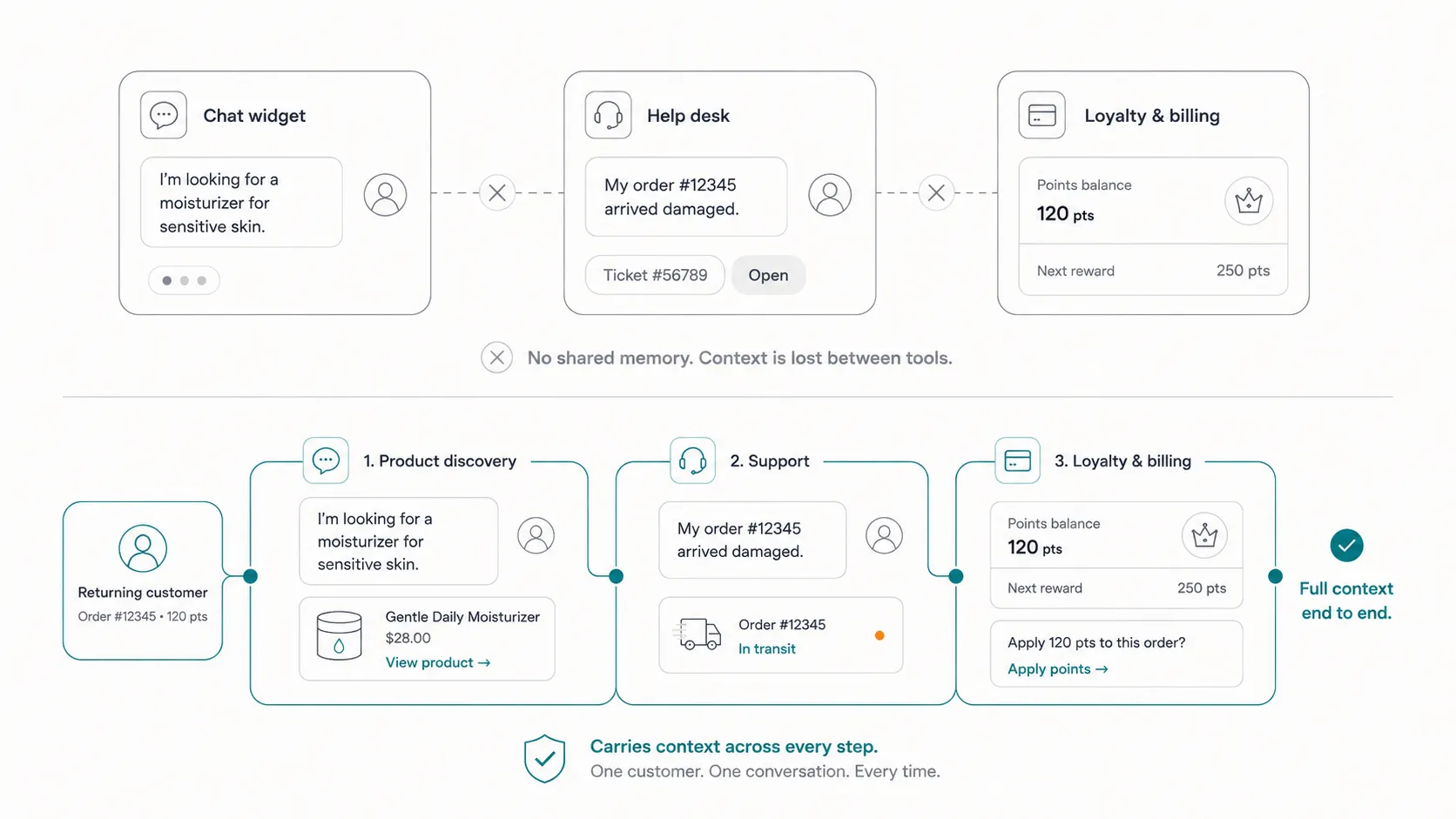
Most storefronts split that same range into pieces the moment a shopper goes online. A chat widget answers product questions from a script and cannot see an order. A help desk handles returns and cannot see what the shopper was just looking at. A third tool handles loyalty or billing and talks to neither of the other two. The shopper is the only one who has to remember the whole conversation, because none of the systems do.
Customers notice immediately, and they are unforgiving about it.
This is not a training gap the way it would be in a physical store. It is an architecture gap. The systems were simply never built to remember.
Sales and service were never two problems
Somewhere along the way, retailers decided that answering a product question and helping with an order were different jobs, staffed by different teams, running on different software. Customers never agreed to that split. They see one relationship, one brand, one conversation they expect to pick up wherever they left it.
The cost of the split shows up on the revenue side more than most teams realize. A large share of what gets logged as a support ticket in ecommerce is actually a buying question asked at the worst possible moment to leave unanswered, and shoppers who get a fast, accurate pre-sales answer convert dramatically better than those who do not.
Executives call organizational silos the single biggest obstacle standing between them and good customer service.
Source: SalesforceThe question is not whether to combine sales and service. Shoppers already experience them as one thing. The question is whether your systems do too.
One visitor. One thread. Four specialists underneath.
The AI Shopping Assistant is built around a simple idea. The shopper gets one conversation. Underneath it, an orchestrator reads each message and quietly routes it to the specialist built for that job. A single question can touch more than one of them and still come back as one answer, in the same thread, without the shopper ever being asked to repeat themselves or start a new chat.
Product Discovery
Browsing and comparison, grounded in the live catalog.
Product Q&A
Fit and specification answers, cited to the exact product copy.
Order Management
Status, swaps and returns, pulling the real order.
Customer Support
Policy and escalation, citing the merchant's actual rules.
None of it runs on a script. Every answer is grounded in the merchant’s own catalog copy, approved documents and connected systems, and merchants decide exactly which agents run, what each one knows and when. A regulated seller can require a compliance disclaimer on certain categories. A specialty retailer can teach the assistant its own fitment logic. The behaviors are configurable because no two catalogs, and no two customer bases, need the same guardrails.
This also is not a helpdesk replacement. Existing tools like Zendesk or Gorgias stay in place for agent-side ticketing, and the assistant connects into them rather than around them. What changes is the front end the shopper actually talks to: from a shopping bot bolted onto a support bot, to one assistant with the full picture.
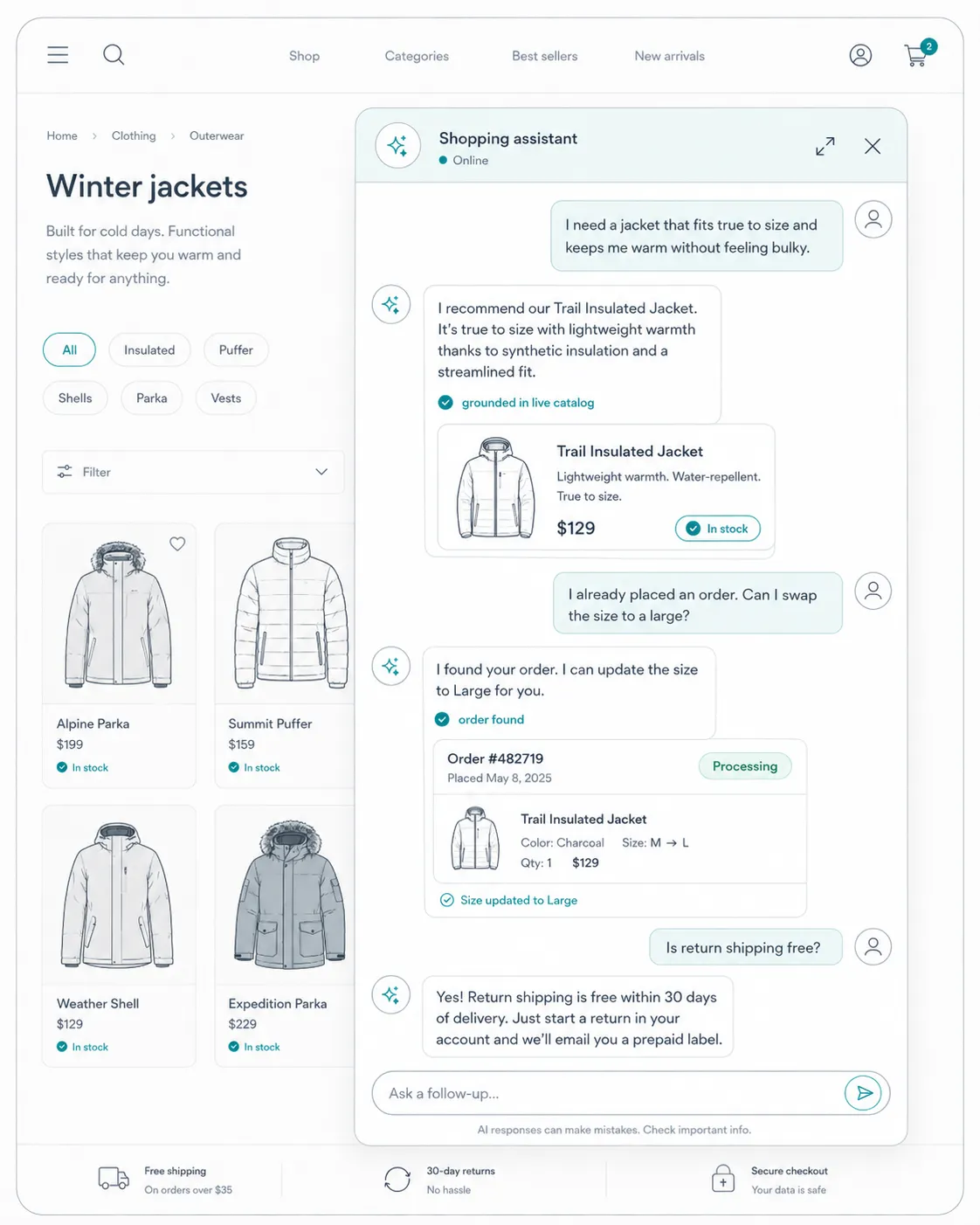
A single thread, in practice:
Three different jobs. One visitor. One thread. The seams the shopper never sees are the whole point.
Every thread is a revenue opportunity, not just a ticket
Reframe the ticket volume for a second. Deflecting a question is a cost saved. Answering it well, in the moment someone is deciding whether to buy, is a sale made or a customer kept. Both outcomes run through the same thread, so it is worth looking at what the industry already knows about getting this right.
Analysts expect AI to resolve the large majority of common service issues on its own within a few years, at meaningfully lower operating cost than a human-only model.
The average cost of an AI-handled resolution — compared with about $7.40 for a human-handled one.
Source: McKinsey, 2026The relationship math cuts both ways: the thread that handles a return well is doing retention work, not just support work. That is the case for building it this way — every agent grounded in the merchant’s own data, one thread, one merchant-controlled orchestration layer, so the sale and the save both happen in the conversation the shopper is already having.
The questions our team gets asked about this
Answered plainly below — the same section our sales engineers walk through on a first call.
Give your visitors the associate they already expect
See how the AI Shopping Assistant handles discovery, comparison, order status and support without ever changing the conversation.
Sales & Service Chat, answered plainly
The straight version of what merchants ask before they buy anything in this category.
A sales and service chat is a single conversational interface where a shopper can ask a product question, compare items, check an order and get support without switching tools or repeating themselves. One assistant handles the whole conversation and remembers everything the shopper has already said, instead of a separate shopping widget and a separate help desk chat that have never met.
A chatbot matches keywords against a script and escalates to a human the moment a shopper asks something it did not anticipate. An AI Shopping Assistant works from live catalog, inventory and order data, understands intent rather than keywords, and keeps conversational memory across the whole session. The practical difference shows up exactly when the script runs out: the chatbot stalls, the assistant answers.
Yes. The AI Shopping Assistant uses an orchestrator that reads each message and routes it to the right specialist behind the scenes, covering product discovery, product questions, order management and customer support, then returns one answer in the same thread. A single conversation can move from a product question to an order status check to a support issue without the shopper starting over.
No. The assistant replaces the storefront-facing chat layer — the widget shoppers talk to before and during a purchase. It connects into your existing help desk rather than around it, so agent-side ticketing, inbox management and escalation still run through the tools your support team already uses.
Because the shopper experiences one relationship with a brand, not separate departments. When a support tool cannot see what a shopper was just browsing, or a sales widget cannot see an existing order, the shopper is forced to repeat information they already gave. More than half of customers say they have left a brand for good after being made to repeat themselves more than once.
Industry research puts the pre-sales share of inbound ecommerce support messages as high as 60%. Questions about sizing, fit, availability and compatibility are buying questions asked at the moment of highest purchase intent, not routine tickets, and answering them well in the same thread as everything else is a conversion lever most teams are not measuring as one.
Accuracy comes from constraining what the assistant is allowed to say, not from open-ended generation. Every answer is grounded in the merchant's own catalog copy, approved documents and connected systems, and merchants control which agents run, what each one knows and when. That is what makes the same interface usable for a firearms retailer with age-gating rules and a specialty distributor with contract pricing.
Both. Deflecting a routine question saves cost, and analysts put the cost of an AI-handled resolution at a small fraction of a human-handled one. Answering a pre-purchase question well, in the moment a shopper is deciding whether to buy, is a sale made or a customer kept — and failed search or unanswered pre-purchase questions already cost retailers more than $2 trillion globally each year in lost sales.
Give your visitors the associate they already expect
See how one AI thread handles discovery, comparison, order status and support — without ever changing the conversation.
Commerce AI you can trust.