AI for regulated commerce you can actually control
Most AI shopping tools were built to sound clever, not to be accountable. In a regulated category, that difference is the whole ballgame — and it comes down to who owns the orchestration layer.
 Adrian LunaSVP of Growth, Webscale AI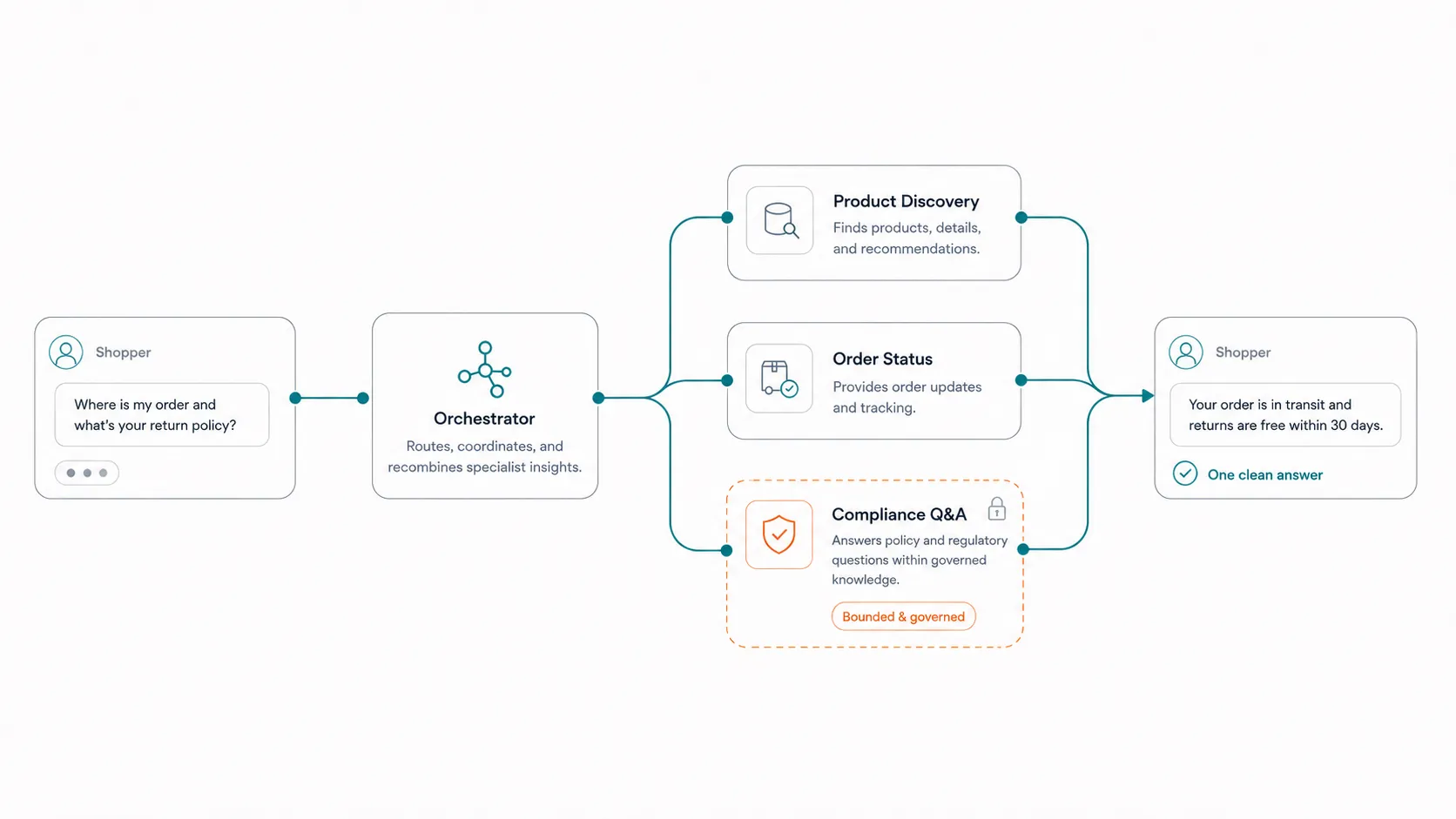
Regulated commerce runs on rules that don’t hold still
If you sell firearms accessories, alcohol, tobacco, cannabis or anything that touches licensed medical practice, you already know that moving fast is not a strategy. It’s the reason legal has a standing seat in your product meetings. Most AI shopping tools on the market were built for merchants who don’t carry that weight. They were built to sound clever, not to be accountable.
Every regulated category has its own version of the same problem. The rules are real, they carry real penalties and they change more often than most product teams can track by hand. An AI system built for general retail has no idea any of this exists. It just answers the question in front of it.
Firearms and accessories
Federal law already keeps a firearm from ever shipping straight to a buyer’s home. It has to route through a licensed dealer, who runs the background check and completes the transfer. Selling without the right federal license carries up to five years in prison and a $250,000 fine, and the ATF spent this year unwinding and rewriting more than thirty of its own rules, including how dealers verify each other’s licenses and how long records need to be kept. A retailer’s AI has to know which items even qualify for a normal checkout and which ones need a dealer selected before the order can go through. Get that wrong and the compliance problem stops being hypothetical.
Alcohol and tobacco
Age thresholds moved for tobacco. Retailers now have to card anyone who looks under 30, not 27, and repeat violations climb toward a $10,000 fine with license revocation on the table after enough of them. Alcohol penalties vary by state in ways that would make a spreadsheet cry. A first offense in Montana costs a seller $500. In Massachusetts it’s a misdemeanor carrying a $2,000 fine or jail time. Shipping is legal almost everywhere except Utah, unless you’re trying to reach a dry county, in which case it isn’t legal there either. None of this is a fixed rulebook an AI can be trained on once and left alone.
Cannabis
Cannabis carries its own layer on top of everything else, because it’s still federally scheduled even where a state has fully legalized it. That single fact touches banking, payment processing and how a platform can even talk about the product without creating exposure. Age verification requirements here tend to be stricter than in almost any other category, often required at checkout, at delivery and sometimes again at account creation, with an auditable record expected for every check. A merchant operating across several states is really operating several different rulebooks at once.
Regulated medical and health-adjacent commerce
The moment a conversation touches a patient’s health information, HIPAA is in the room, and violations can run up to $1.5 million per incident. Several states passed new disclosure rules in 2026 requiring AI tools to clearly identify themselves as AI and avoid language that could be mistaken for a licensed provider’s advice. A pharmacy, a distributor selling to licensed practitioners or a wellness brand handling any patient detail is one careless answer away from a problem that has nothing to do with ecommerce and everything to do with practicing medicine without a license.
Why generic AI chat tools break in these categories
Most AI shopping tools on the market today pull from a product feed and a language model, then improvise the rest. That’s fine for a shoe retailer. A wrong answer about sizing is embarrassing. A wrong answer about which state a suppressor can ship to, whether a supplement claim is allowed on a product page or whether a patient’s question needs a clinician instead of a bot is a different category of wrong. Bolt-on AI tools were never asked to solve for that, because most of the companies building them don’t carry that risk themselves.
The pattern shows up the same way every time:
- It’s trained on a static export. The tool draws from a stale catalog snapshot instead of live inventory and policy data, so what it says and what’s true drift apart.
- It has no concept of jurisdiction. It gives the same answer to a shopper in California and a shopper in Utah, because a state was never part of the question it was built to answer.
- Nobody inside the merchant controls it. The vendor owns the model’s behavior, not the retailer selling a regulated product under its own name and its own license.
Who’s actually on the hook when the AI gets it wrong
This part used to be theoretical. It isn’t anymore. In 2024, a Canadian tribunal ruled on a case that’s since become the reference point for the whole industry. Air Canada’s website chatbot gave a customer incorrect information about a bereavement fare, and the airline argued the bot was a separate entity responsible for its own words. The tribunal didn’t buy it.
A company is responsible for everything on its site — whether the content comes from a static page or a conversation with an AI.
A similar case hit a software company in 2025 when its support bot invented a policy that didn’t exist. Insurers have started underwriting specifically for AI hallucination losses, and FINRA’s 2026 oversight report added a new warning telling brokerages to watch for AI agents acting outside the scope anyone actually gave them.
None of that is firearms-specific or cannabis-specific. It applies to anyone putting a conversational interface in front of a customer. But it lands hardest in regulated commerce, because the gap between “the AI said something slightly off” and “the AI made an unlicensed compliance claim about a controlled product” is much smaller than most teams assume. A generic model has no way to know it crossed that line. It sounds equally confident either way.
What owning the orchestration layer actually means
An AI Shopping Assistant isn’t one model answering every question. Underneath it sits an orchestrator that reads each request and routes it to the specialist agent built to handle it — product discovery to one, order status to another, a compliance-sensitive question to a third that’s scoped tighter than the rest. A compound question can touch several of those agents in a single conversation and come back to the shopper as one answer. The shopper never sees the seams. The merchant sees every one of them.
Owning that layer means the merchant, not a vendor, decides which agents run, what each one is allowed to know and what happens the moment a question falls outside its lane. In practice that shows up as a handful of concrete controls:
- Per-agent instructions that layer on top of default behavior, so a Q&A agent can be told to include a specific disclaimer every time a certain product category comes up.
- Custom behaviors that trigger on specific language, like automatically escalating anything that resembles a controlled-substance interaction question to a person instead of letting a model attempt it.
- Grounded answers that point back to the exact line of approved content behind them, so there’s no free-form invention happening in a category where invention is the actual risk.
- An observable record of what an agent knew and why it answered the way it did — the difference between a shrug and a real answer when someone asks how a specific response got generated.
This is the same logic as constrained access in security work. Limiting what a system can reach isn’t a downgrade. It’s the design choice that makes the system trustworthy enough to put in front of a regulator, a payment processor or a plaintiff’s attorney in the first place.
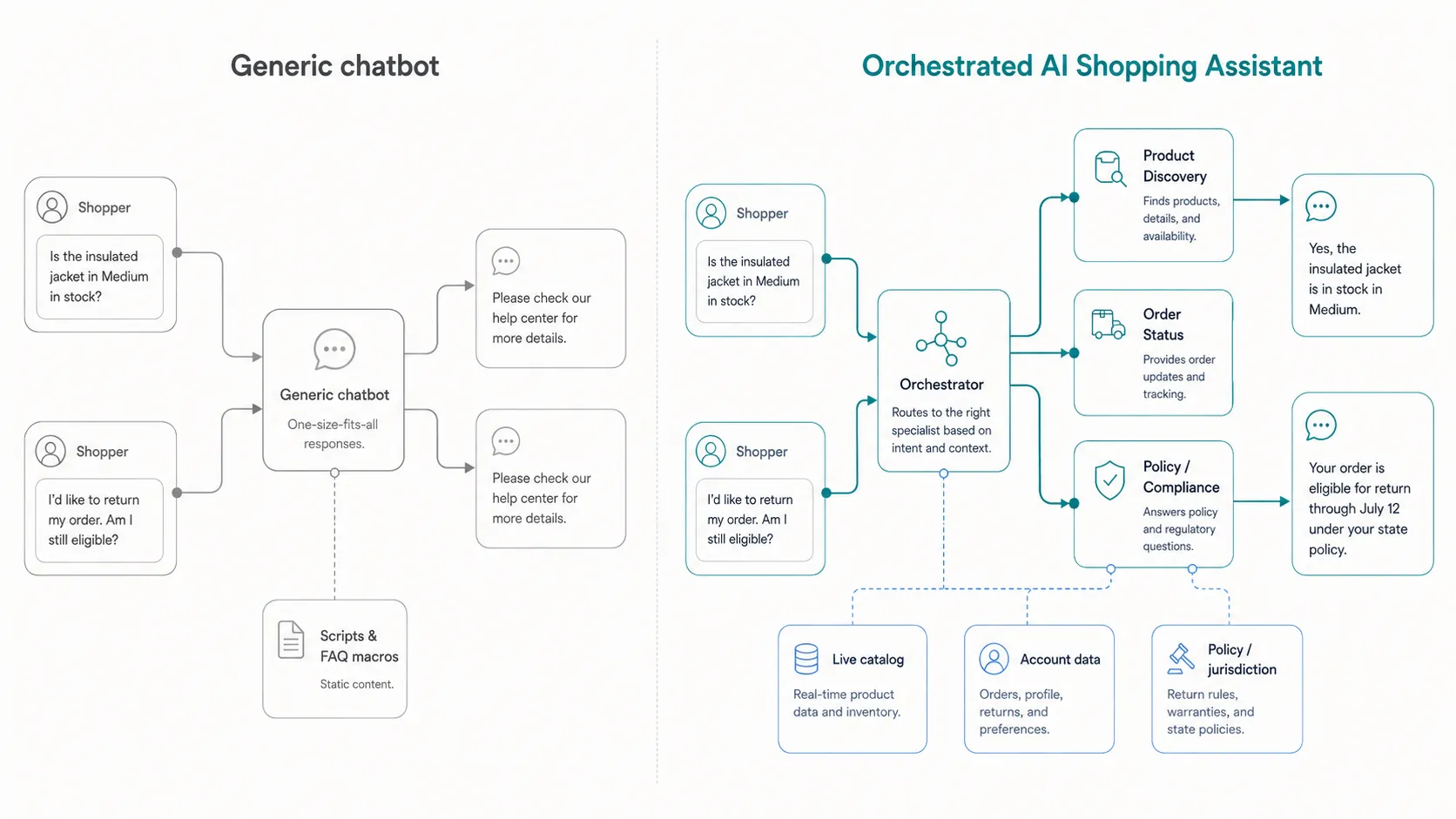
| Compared on | Generic chatbot | Orchestrated AI Shopping Assistant |
|---|---|---|
| What it answers from | Scripts and FAQ macros | Your live catalog, account and policy data |
| When a question falls outside its script | Escalates or guesses | Routes to the right specialist agent or a person |
| Awareness of jurisdiction | None — same answer everywhere | Scoped per agent, per category, per state |
| Who decides what it’s allowed to say | The vendor’s default model behavior | You, through instructions and custom behaviors you control |
| What you can hand a regulator | A vendor’s marketing page | A record of what the agent knew and why it answered that way |
What this looks like by category
Different categories, same underlying decision: the merchant decided in advance what the AI is allowed to do, instead of finding out after the fact what it did.
Firearms & accessories
A suppressor and accessories retailer’s assistant should answer detailed fitment and compatibility questions all day, and it should also know the difference between a part that ships anywhere and one that needs a dealer transfer — without a shopper ever having to ask the second question out loud.
Premium tobacco
A premium tobacco retailer’s assistant can run full product discovery and act as a knowledgeable sommelier for a customer picking a first cigar, while the same system quietly withholds anything that would need an age check it hasn’t performed yet.
Licensed cannabis
A licensed cannabis retailer’s assistant can talk through strain effects and dosage format the way a good budtender would, scoped to only the products and claims approved for that customer’s state, with nothing carrying over from a jurisdiction where a different rule applies.
Medical distribution
A distributor selling to licensed practitioners can let its assistant answer detailed product and ordering questions from an account it already knows is verified, while routing anything that edges toward a clinical recommendation straight to a person, every time, without exception.
The case for getting this right
This isn’t only a risk-avoidance argument. There’s a real upside to being the merchant whose AI a regulated shopper actually trusts. Buyers already behave differently in high-stakes categories. A 2026 consumer study from Yext found people don’t fact-check a recipe recommendation, but before choosing a doctor or refinancing a mortgage, they verify everything, because the cost of being wrong scales with the stakes of the decision. A firearms buyer, a cannabis patient and someone shopping for a medical device are exactly the shoppers who will notice if your AI hedges, contradicts itself or clearly doesn’t know your own catalog.
Put those two things together and the opportunity is obvious. Most competitors in a regulated category are either avoiding AI out of caution or running a bolt-on tool that quietly gets things wrong and hopes nobody notices. A merchant that’s actually built the orchestration to get it right consistently, in a category where consistency is rare, has a real edge. It shows up as fewer abandoned conversations, fewer escalations that never should have needed a human in the first place, and a shopper who comes back because the last answer they got was correct.
Where regulated brands get this wrong
A few patterns show up over and over in regulated categories that get AI wrong. Any one of these is fixable on its own. All four together is how a regulated merchant ends up as the case study nobody wants to be.
- The AI is unconstrained. It was set up like a general retail chatbot, so it will answer literally anything a shopper types, including things it has no business answering.
- Nobody owns the behavior. The vendor controls the model’s defaults, and the merchant has no way to change what it says about a specific product category without opening a support ticket.
- There’s no jurisdiction logic anywhere. One answer goes out to every shopper regardless of the state they’re buying from.
- There’s no record of anything. If a regulator or a customer asks why the AI said what it said, there’s no way to reconstruct the answer.
None of this requires walking away from AI in a regulated category. It requires building it the way the category actually demands, with the merchant in control of what each agent knows, what it’s allowed to say and what happens the moment a question needs a person instead of a model. That’s the whole argument for owning the orchestration layer instead of renting somebody else’s chatbot. The rules in your category were never going to hold still. Your AI has to be built to keep up with them anyway.
The questions our team gets asked about this
Answered plainly below — the same section our sales engineers walk through on a first call.
Regulated commerce AI, answered plainly
The straight version of what merchants in regulated categories ask before they buy anything in this space.
AI doesn’t perform the age check itself. Federal and state law still require identity verification at checkout, and for tobacco that means carding anyone who looks under 30 under current rules. An AI Shopping Assistant can handle product discovery and questions right up to that point, then hand off cleanly to whatever verification and checkout controls are already enforcing the actual legal requirement.
The merchant is. A 2024 tribunal ruling against Air Canada set the precedent that a company is responsible for everything its AI says, the same way it’s responsible for a static page on its own site. Nobody has successfully argued the bot is a separate legal actor since.
A chatbot matches a question to a script and escalates when nothing fits. An AI Shopping Assistant works from your live catalog and account data, grounds each answer in a specific piece of your approved content and can be scoped so it never wanders into products, claims or jurisdictions you haven’t cleared it for.
Yes, if the orchestration layer is built for it. That logic has to live in the same routing decision that picks which agent answers a question. A basic FAQ chatbot has no concept of state-by-state rules at all — it has one answer, and it gives that answer to everyone.
If the assistant ever collects, stores or responds to anything that identifies a patient or their health details, yes — and violations can run up to $1.5 million per incident. The safer pattern is to scope the assistant to product and account questions only, and route anything clinical straight to a person.
Limit what it’s allowed to draw from. An assistant constrained to your indexed catalog, approved documents and specific URLs can’t invent a claim that isn’t already in that content, because there’s nothing outside it to pull from. That’s an architecture decision, not a setting you toggle after the fact.
Yes, with the same discipline any regulated category needs. Age verification stays at checkout where it belongs, product visibility and claims get scoped per state, and the assistant never surfaces something approved in one jurisdiction to a shopper in another. The federal and state conflict is a catalog and shipping problem more than an AI problem, and it gets solved in the same orchestration layer.
It means the merchant decides which AI agents run, what each one is allowed to know and what happens when a question falls outside its scope, instead of a vendor’s default model behavior making that call. It’s the difference between installing a chat widget and running a system you can explain, adjust and defend if anyone ever asks how a specific answer came about.
No. Disclosures still need to exist as real content and be enforced at checkout the way they always have been. What the assistant adds is consistency — surfacing the right disclaimer every time a certain topic comes up in conversation, instead of depending on a person to remember it every single time.
Talk to us about regulated commerce
See what an AI Shopping Assistant looks like when you own the orchestration layer — scoped to your catalog, your jurisdictions and your compliance rules.
Start a 15-day pilot. Tell us about your store and we’ll confirm fit before setup.
Commerce AI you can trust.