Keyword search is quietly costing you your highest-intent shoppers
The people typing into your search bar already know what they want. Most stores still hand them a system built to match strings, not the way people actually describe things.
 Adrian LunaSVP of Growth, Webscale AI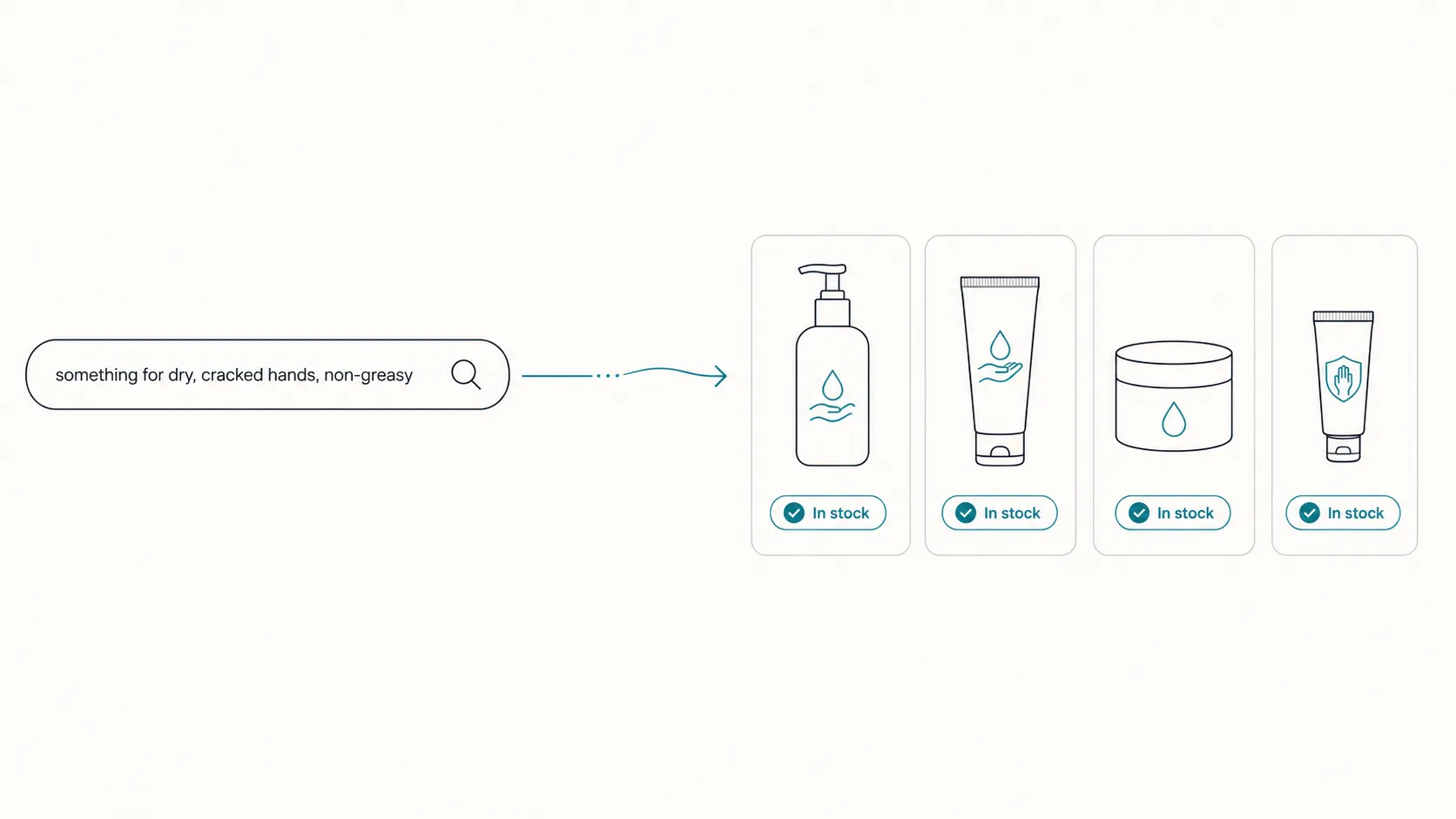
The moment keyword search gives up on a shopper
I look at a lot of pilot session recordings, and one pattern keeps showing up. A shopper types something specific and human into the search bar. “Something for dry, cracked hands that won’t leave a greasy residue.” “A crossbow string for a bow I bought three seasons ago.” “The part number stamped on the side of my compressor, but I can only read half of it.” The engine reads five or six disconnected words, checks them against product titles, finds no exact match, and returns nothing. The shopper does not try a second phrasing. They leave.
Baymard Institute has spent more than a decade running this exact test in a lab, with real shoppers, on real retail sites. Its most recent search benchmark found that close to half of ecommerce sites still greet a failed search with a blank page and a suggestion to check spelling. That blank page is where a store loses a shopper who had already decided to buy something. They just needed help finding it.
Lost each year in the US alone to shoppers who could not find what they came for — more than $2 trillion worldwide. About eight in ten of those shoppers say a bad search experience pushes them toward a competitor.
Source: Google Cloud & Harris Poll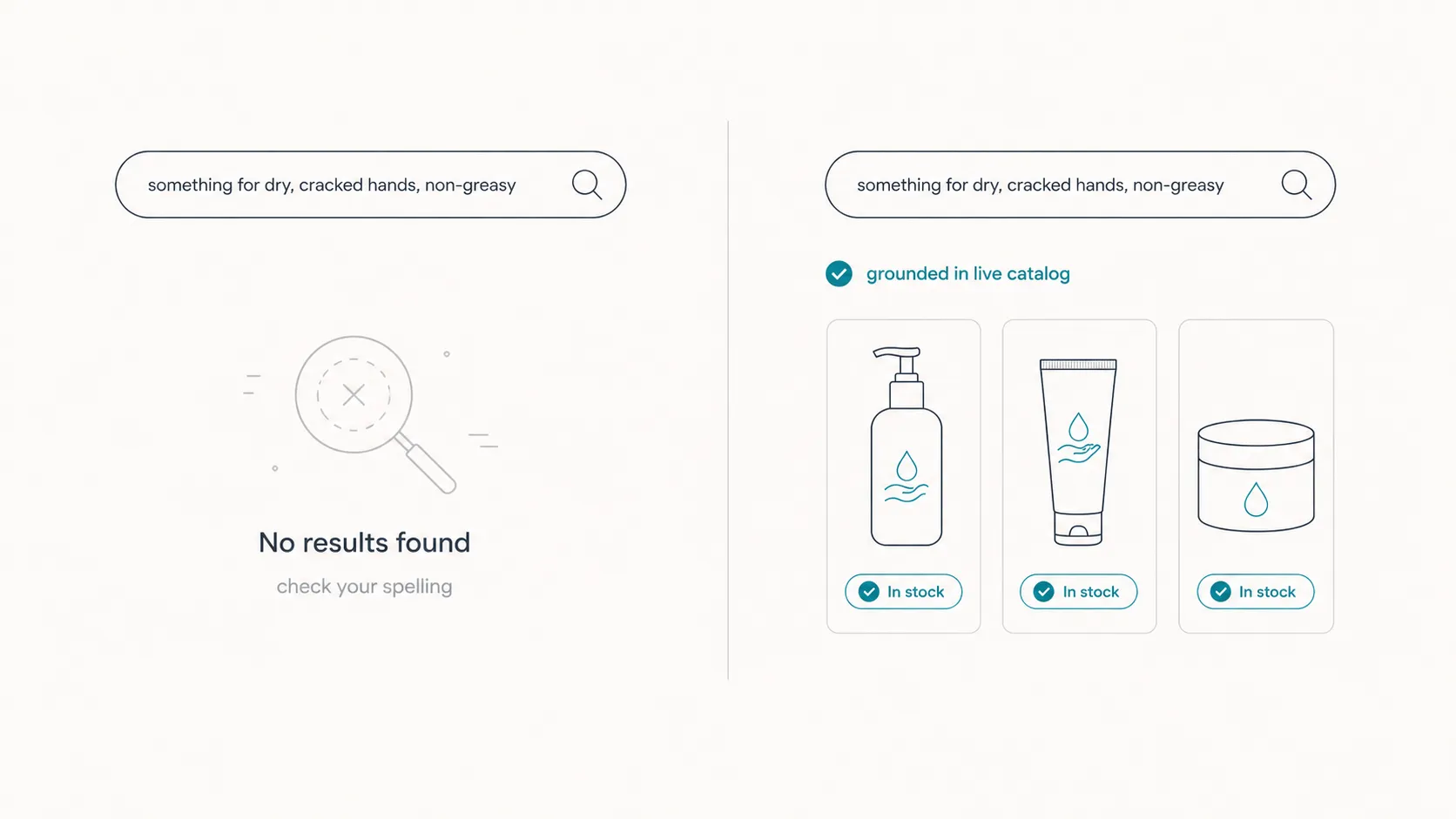
Search traffic is not like your other traffic
Here is the part that should bother every merchandiser more than it usually does. The shoppers who use your search bar are not casual visitors. They already decided what they want and are trying to tell you. Across independent studies, visits that use onsite search consistently produce somewhere between 30 and 60 percent of an ecommerce site’s total revenue, despite making up a fraction of total traffic. Average order value runs meaningfully higher for search users than for browsers.
Put those two facts together and the math gets uncomfortable. Your search bar is disproportionately responsible for revenue, and it is also disproportionately likely to be the reason a ready buyer leaves. Average cart abandonment across ecommerce sits around 70 percent, and a real share of that abandonment never reaches the cart at all. It happens one step earlier, at a search box that could not translate a real sentence into a real product.
Why exact-match search breaks down
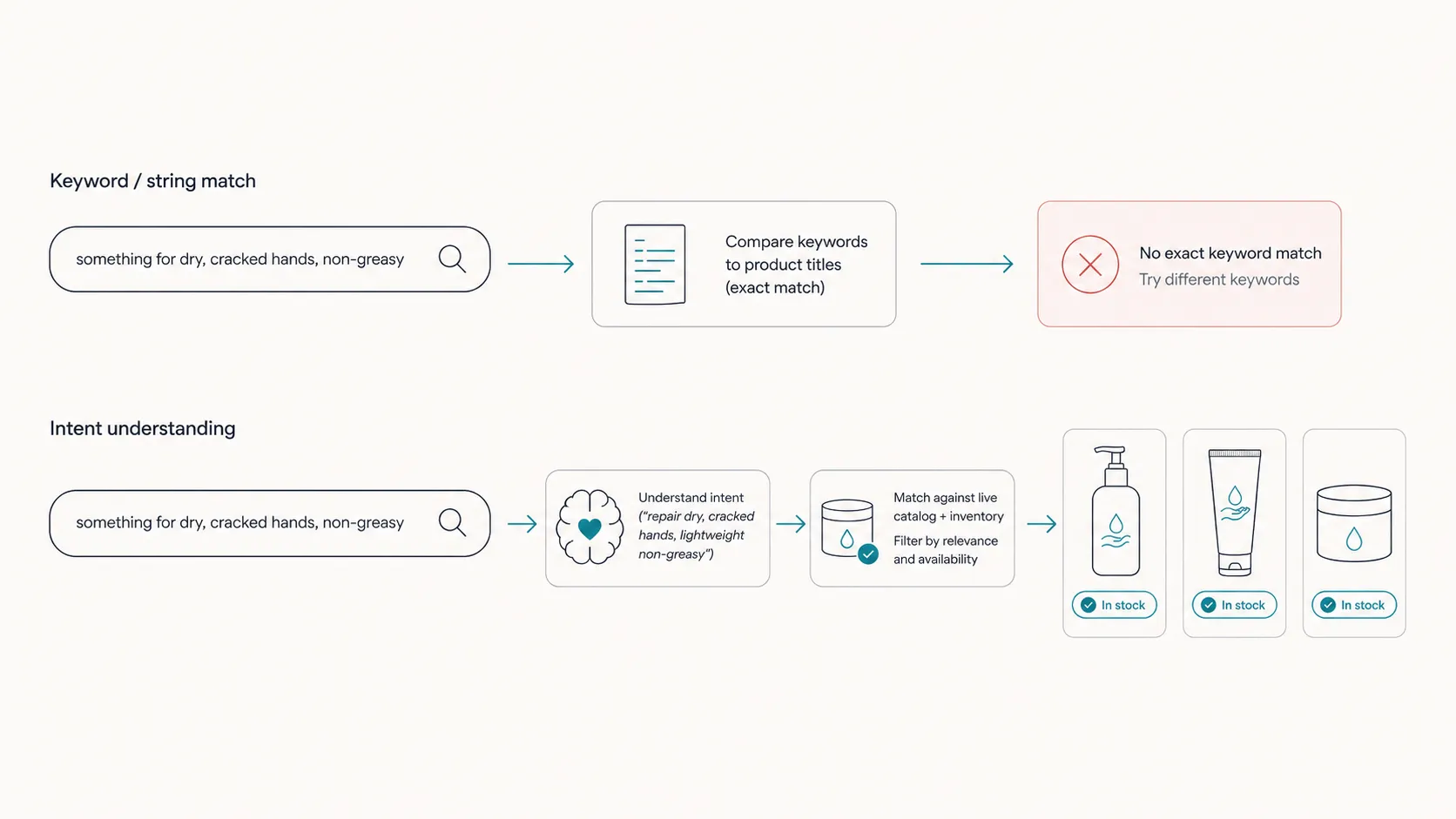
Keyword search was built for a narrower job than the one it is being asked to do now. It compares the string a shopper typed against the strings in a product catalog, and it rewards an exact or near-exact match. That works fine when a shopper already knows and uses the merchant’s own vocabulary. It falls apart the moment a shopper describes a problem instead of a product name, uses a word the catalog does not, or asks a question that has no single field to search against.
Most keyword failures trace back to the same handful of causes:
- Vocabulary mismatch. A shopper searches “hair dryer.” The catalog says “blow dryer.” Zero results, and the product was in stock the entire time.
- Descriptive queries. A shopper describes a symptom, a use case or a constraint rather than a product name. A keyword engine has nothing to match that against.
- Technical and fitment complexity. In B2B and specialty retail, shoppers search by SKU fragments, part numbers or compatibility — a specific year, make or model. Wildcard matching against a large catalog returns a wall of technically matching, actually irrelevant results.
That is a structural limit of matching characters instead of understanding what a person is asking for, and it shows up the same way on almost every catalog we look at.
The shift analysts have already started naming
This is not a hypothetical maturity curve someone in marketing invented. Gartner now tracks Search and Product Discovery as its own market, and its 2026 research says plainly that conversational search and guided-selling assistants are moving from a novelty into the center of that category. Forrester’s research on agentic commerce, published this spring, tells brands not to wait on the big AI platforms to send them traffic and to add assistive AI to their own site now, so shoppers can ask questions in plain language and get guided toward the right product.
AI-referred shopping traffic went from converting worse than every other channel in early 2025 to converting meaningfully better than every other channel by March 2026 — a full reversal in a single year.
Source: Adobe Digital InsightsThe traffic data backs up the urgency. Shoppers are already comfortable describing what they want to a machine. The only open question is whether that conversation happens on a competitor’s site or yours.
What changes when search understands intent instead of characters
Intent-driven search does not throw out the search bar. It changes what happens after someone uses it. Instead of matching a string, the system interprets what the shopper is trying to accomplish, checks that against live catalog and inventory data, and returns products that fit the need rather than the letters.
The category has real numbers behind it, and they are worth stating plainly with attribution rather than folded into a vague promise.
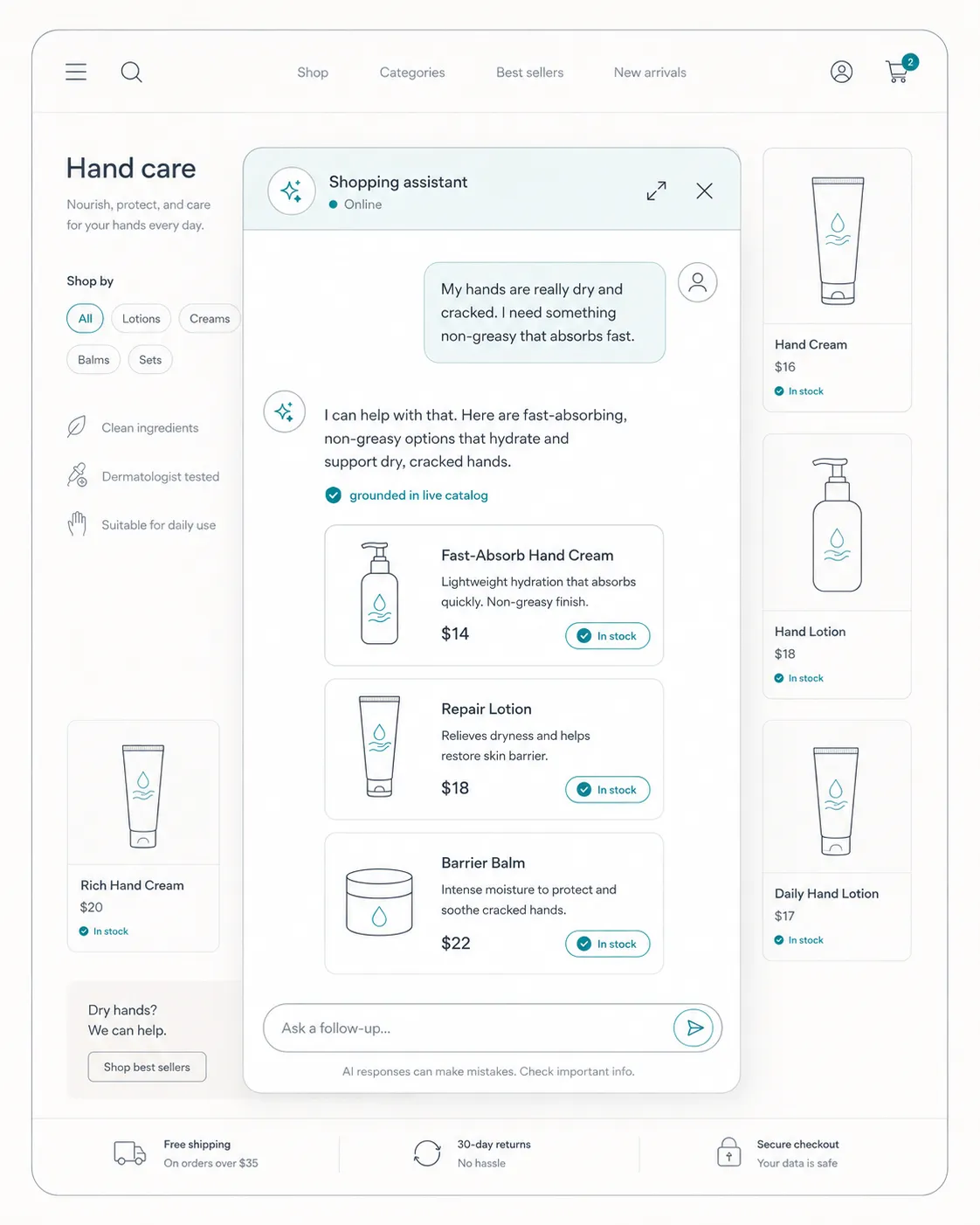
This is what our AI Shopping Assistant’s Product Discovery agent is built to do. A shopper describes a problem in their own words and gets relevant, in-stock results back, the way they would from a knowledgeable associate on the floor. Product Q&A, its companion agent, grounds every answer to the exact line of product copy that supports it, so a shopper gets a real answer instead of a confident guess. Because it runs on live data instead of a stale export, it will not recommend something that sold out an hour ago.
None of that requires a shopper to learn a new interface. The conversation can start in the same search bar they already use, or in a dedicated assistant window, and both draw on the same catalog, pricing and inventory feeding the rest of your storefront.
Where this matters most
Every merchant loses something to broken search. The ones who lose the most share a pattern. Retailers with deep, technical or fitment-dependent catalogs, where a shopper knows what they need but not the SKU or part number that describes it. Layer B2B on top of that, where buyers arrive already knowing exactly what they need and have no patience for a catalog that cannot understand a part number, a spec or a compatibility question on the first try. One recent survey of B2B ecommerce leaders ranked search and recommendations as their single biggest technology investment priority, ahead of the commerce platform itself.
If your shoppers have ever had to call, email or open a chat window just to ask “does this fit,” your search is not a UX problem. It is a lost sale with a phone number attached.
The questions our team gets asked about this
Answered plainly below — the same section our sales engineers walk through on a first call.
Where to start
You do not have to solve this everywhere at once. Most merchants start with the search bar and category pages already driving the bulk of their revenue, prove the model there, then expand into full conversational discovery. If your team wants to see what Product Discovery looks like against your own catalog, that is a conversation worth having before your next planning cycle, not after it.
Product Discovery, answered plainly
The straight version of what merchants ask before they buy anything in this category.
Search that interprets what a shopper means instead of matching the literal words they typed. It combines natural language understanding with live catalog and inventory data, so “something for dry, cracked hands” and “unscented hand cream for eczema-prone skin” can both correctly surface the same product, even if neither phrase appears in the product title.
No. A chatbot deflects. It matches a question to a decision tree or a knowledge base article and hands off when it cannot find a match. Intent-driven search and an AI Shopping Assistant work from live data, hold context across a conversation and are built to help someone decide and buy, not just answer one question and stop.
No. It runs underneath the search experience shoppers already use, on category pages and in a dedicated assistant, and it connects to the catalog, pricing and inventory data you already have. There is no rip and replace.
It should not, and that is worth checking before you buy anything in this category. Ours grounds every product answer to the specific line of product copy or documentation that supports it, and merchants control exactly what content, catalog and systems the assistant can draw from. Constrained context is the point, not a limitation.
Yes. Merchants configure agent behavior per use case, from fitment and compatibility logic to category-specific disclaimers and compliance language, and the same architecture that handles a simple product question also handles a large catalog with customer-specific pricing.
Talk to us about Product Discovery
See what intent-driven, conversational discovery looks like against your own catalog — before your next planning cycle, not after it.
Start a 15-day pilot. Tell us about your store and we’ll confirm fit before setup.
Commerce AI you can trust.